
ANGKOR WAT TEMPLE
Lorem ipsum dolor sit amet, consectetur adipiscing elit. Ut elit tellus, luctus nec ullamcorper mattis, pulvinar dapibus leo.
About US..
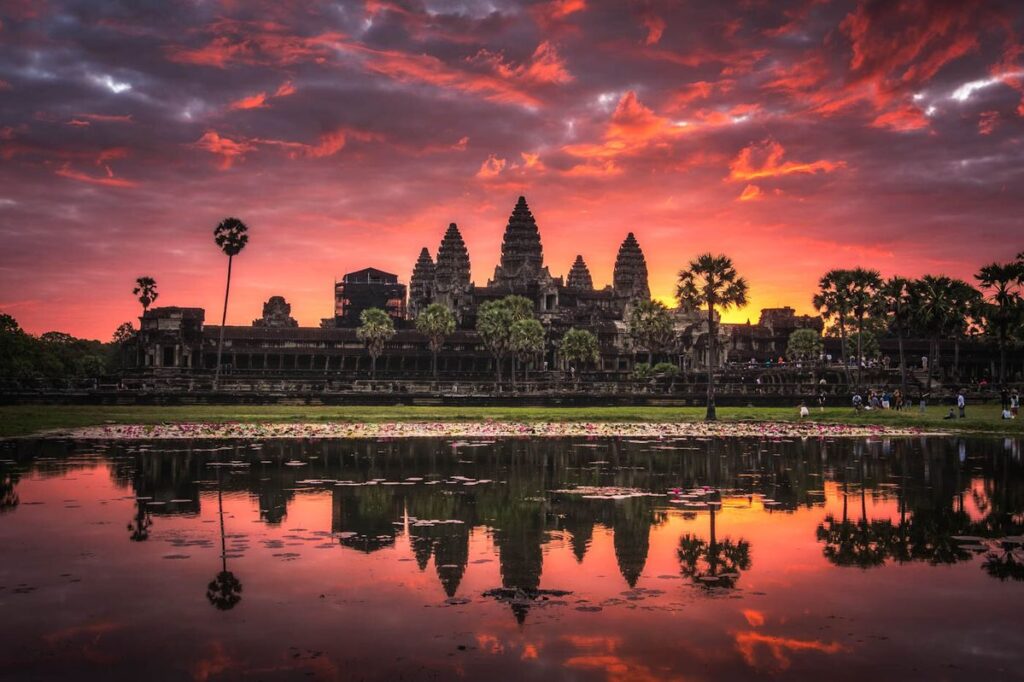
Angkor Wat
Angkor Wat (/ˌæŋkɔːr ˈwɒt/; Khmer: អង្គរវត្ត, ‘City/Capital of Temples‘) is a Theravada Buddhist temple complex and the largest religious complex in the world. Located on a site measuring 162.6 hectares (1.6 km2; 401.8 acres) within the ancient capital of Angkor, it was constructed between 1113 and 1150 CE during the reign of the Khmer king Suryavarman II as a Hindu temple dedicated to Vishnu. From the late 13th century onward, the complex was gradually transformed into a Buddhist temple and has remained an active center of Buddhist worship for centuries. Angkor Wat is characteristics of Khmer architecture. Unlike most Angkorian temples, it is oriented toward the west. It is a symbol of Cambodia and appears on the Cambodian national flag.
China
The first humans in China arrived during the Paleolithic era. By the 2nd 8th–3rd centuries BCE saw a breakdown in the authority of the Zhou dynasty, accompanied by the emergence of administrative and military techniques, millennium BCE dynastic states had emerged in the Yellow River basin. The 8th–3rd centuries BCE saw a breakdown in the authority of the Zhou dynasty, accompanied by the emergence of administrative and military techniques,


Chines
The first humans in China arrived during the Paleolithic era. By the 2nd 8th–3rd centuries BCE saw a breakdown in the authority of the Zhou dynasty, accompanied by the emergence of administrative and military techniques, millennium BCE dynastic states had emerged in the Yellow River basin. The 8th–3rd centuries BCE saw a breakdown in the authority of the Zhou dynasty, accompanied by the emergence of administrative and military techniques,